Most guides on CE vs UKCA marking Northern Ireland companies find online are wrong — or at least out of date. They will tell you that CE marking does not work in Great Britain, and that NI companies need UKCA marking to sell to customers in England, Scotland or Wales. That changed in October 2024.
The UK government’s Product Safety and Metrology (Amendment) Regulations 2024 extended recognition of CE marking in Great Britain indefinitely. This fundamentally changes the compliance picture for NI electronics companies — and most competitor content has not caught up.
This guide to CE marking Northern Ireland reflects the current rules as of early 2026 and explains exactly what NI-based companies need to know about product compliance.
CE vs UKCA: The Basics
CE marking shows that a product meets EU health, safety and environmental requirements. It has been the standard for selling products in the European Economic Area (EEA) for decades.
UKCA marking (UK Conformity Assessed) was introduced as the post-Brexit equivalent for products sold in Great Britain (England, Scotland and Wales). It uses largely the same technical standards as CE but requires a separate declaration and, in some cases, a UK-based Approved Body. However, since 1 October 2024, CE marking is accepted indefinitely in Great Britain alongside UKCA for most product categories. This means UKCA marking is now optional for the majority of products — though it remains available for businesses that prefer it.
CE vs UKCA Marking in Northern Ireland
Under the Windsor Framework, Northern Ireland follows EU rules for goods. This means:
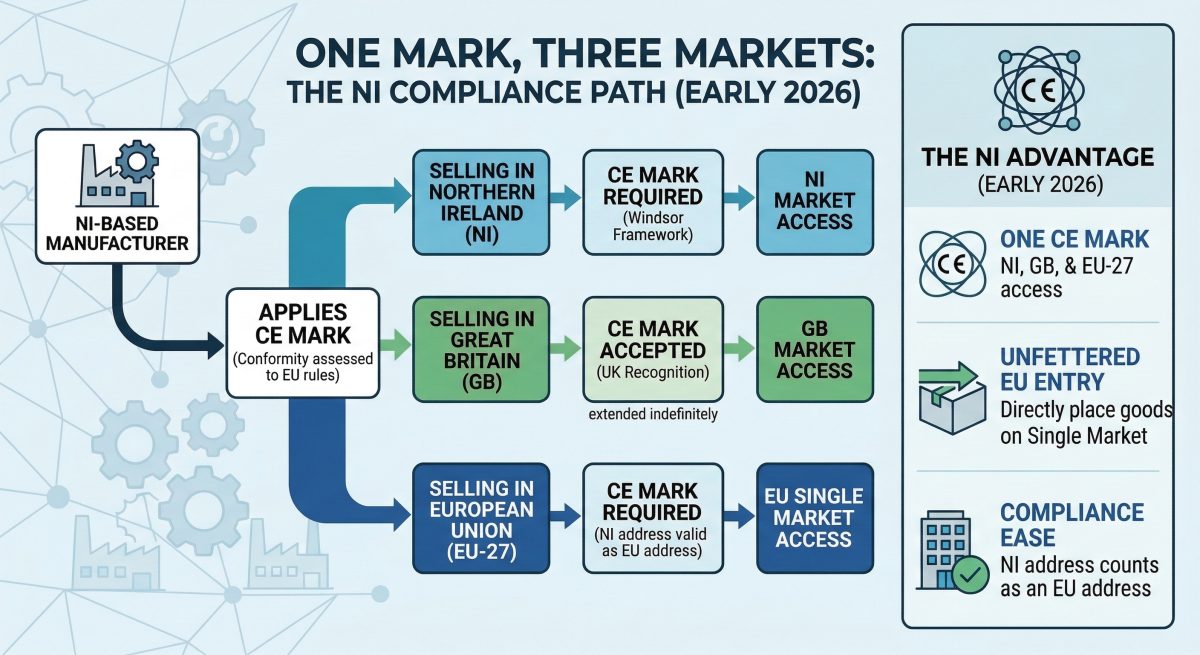
- Selling in Northern Ireland — Your product needs CE marking (EU rules apply under the Windsor Framework)
- Selling in Great Britain — CE marking is now accepted indefinitely (since Oct 2024). NI goods also have unfettered market access to GB. UKCA is optional.
- Selling in both NI and GB — CE marking alone covers both markets. No separate UKCA marking is needed for most products.
- Selling in the EU — CE marking is required, and NI products have unfettered access to the EU single market
This is a significant simplification from the pre-2024 situation, where NI companies genuinely needed dual marking for GB sales. Today, the real NI advantage is not about GB access (CE now works there for everyone) — it is about unfettered EU market access. NI-based manufacturers can place CE-marked products directly into the EU single market without additional barriers, something GB-based competitors cannot easily do.
Which Directives Apply to Electronic Products?
Most electronic products need to comply with one or more of these EU directives (and their UKCA equivalents):
| Directive | Covers | Applies When |
|---|---|---|
| EMC Directive (2014/30/EU) | Electromagnetic compatibility | Almost all electronic products |
| Low Voltage Directive (2014/35/EU) | Electrical safety | Products operating between 50-1000V AC or 75-1500V DC |
| Radio Equipment Directive (2014/53/EU) | Radio transmitters and receivers | Any product with wireless: Bluetooth, Wi-Fi, cellular, LoRa, NB-IoT. Internet-connected radio products must also meet the cybersecurity requirements of Delegated Regulation (EU) 2022/30, in force since 1 August 2025 |
| Machinery Directive (2006/42/EC) | Safety of machinery | Electronic controls for machines — see our OEM machinery electronics. Note: replaced by Regulation (EU) 2023/1230 from Jan 2027. |
| RoHS Directive (2011/65/EU) | Restriction of hazardous substances | Almost all electronic products |
What Does the Compliance Process Look Like?
For most electronic products, the process follows these steps:
- Identify applicable directives — Determine which directives apply to your specific product
- Identify harmonised standards — Find the specific test standards (e.g. EN 55032 for emissions, EN 61000-4-2 for ESD immunity)
- Design for compliance — This is where having your PCB designer understand EMC from the start saves time and money
- Test at an accredited lab — An accredited test laboratory runs the required tests against the harmonised standards
- Prepare technical documentation — Technical file containing test reports, risk assessments, schematics, user instructions
- Issue Declaration of Conformity — A legal document signed by the manufacturer declaring compliance
- Apply the marking — CE marking, UKCA marking, or both on the product and packaging
Common Pitfalls for NI Companies
1. Assuming one mark covers every market without checking
Since October 2024, CE marking is accepted in GB indefinitely — but you should still verify that your specific product category is covered by the extension. Some niche regulated products (e.g. certain medical devices, construction products) may have different timelines or requirements. Always check the latest GOV.UK guidance for your product type before assuming CE alone is sufficient.
2. Ignoring RED for wireless products
If your product has Bluetooth, Wi-Fi, cellular or any radio technology, the Radio Equipment Directive applies. This is a more demanding (and expensive) certification process than basic EMC testing. For internet-connected devices it includes the cybersecurity requirements that became mandatory on 1 August 2025, and a Notified Body is needed wherever the relevant harmonised standards are not applied in full. Plan for it from the start.
3. Treating compliance as an afterthought
The most expensive compliance failures happen when a product is designed without EMC in mind and then fails testing. Fixing EMC problems on a finished product means PCB respin, re-testing and delays. Designing for compliance from day one is always cheaper.
4. Overlooking Authorised Representative requirements
NI businesses selling into GB generally have lighter requirements here — your NI address is often sufficient since Northern Ireland is part of the UK internal market. However, if you are selling into the EU from outside the EEA (or if a non-EU manufacturer is using your NI entity as a route to market), you may still need an EU Authorised Representative. Check the specific requirements for your directives.
What Does Compliance Cost?
Typical costs for electronic product certification (test laboratory fees — engineering support for design review, pre-compliance testing and remediation is additional):
| Item | Typical Cost |
|---|---|
| EMC testing (emissions + immunity) | £2,000 – £5,000 |
| Safety testing (LVD) | £1,500 – £4,000 |
| RED testing (wireless products) | £3,000 – £8,000 |
| Technical documentation | £1,000 – £3,000 |
| UKCA marking (if needed alongside CE) | Additional £1,000 – £3,000 for separate declarations (optional since Oct 2024) |
For a typical non-wireless electronic product, budget £3,000-£8,000 for full CE marking. For a wireless IoT product needing both CE and UKCA, expect £8,000-£15,000.
The NI Advantage
With CE marking now accepted across NI, GB and the EU, Northern Ireland’s position in 2026 is genuinely advantageous:
- One mark, three markets — CE marking now covers Northern Ireland, Great Britain and the EU. No other UK region has unfettered access to the EU single market.
- Unfettered EU access — NI manufacturers can place CE-marked goods directly into the EU market without additional barriers. GB-based competitors face more friction.
- EU supply chains — NI companies can source CE-marked components from EU suppliers without additional conformity assessment
- Attractive to EU customers — For EU OEMs looking for a UK-based design partner with seamless market access, NI is the obvious choice
How Lumen Electronics Can Help
At Lumen Electronics, we handle CE and UKCA compliance as part of our integrated design and manufacturing process. Because we design the hardware and write the firmware, we understand the product inside out when it goes for testing — and we can fix issues fast if they arise.
Based in Northern Ireland, we navigate the post-Brexit regulatory landscape so our clients do not have to. Whether you need CE marking for EU market access, want to understand the latest UKCA changes, or need help with a specific directive — we know the rules, the test labs and the process.